What 1,362 hacks taught our questionnaire
By Verdict Research. Published 20 November 2026.
In short
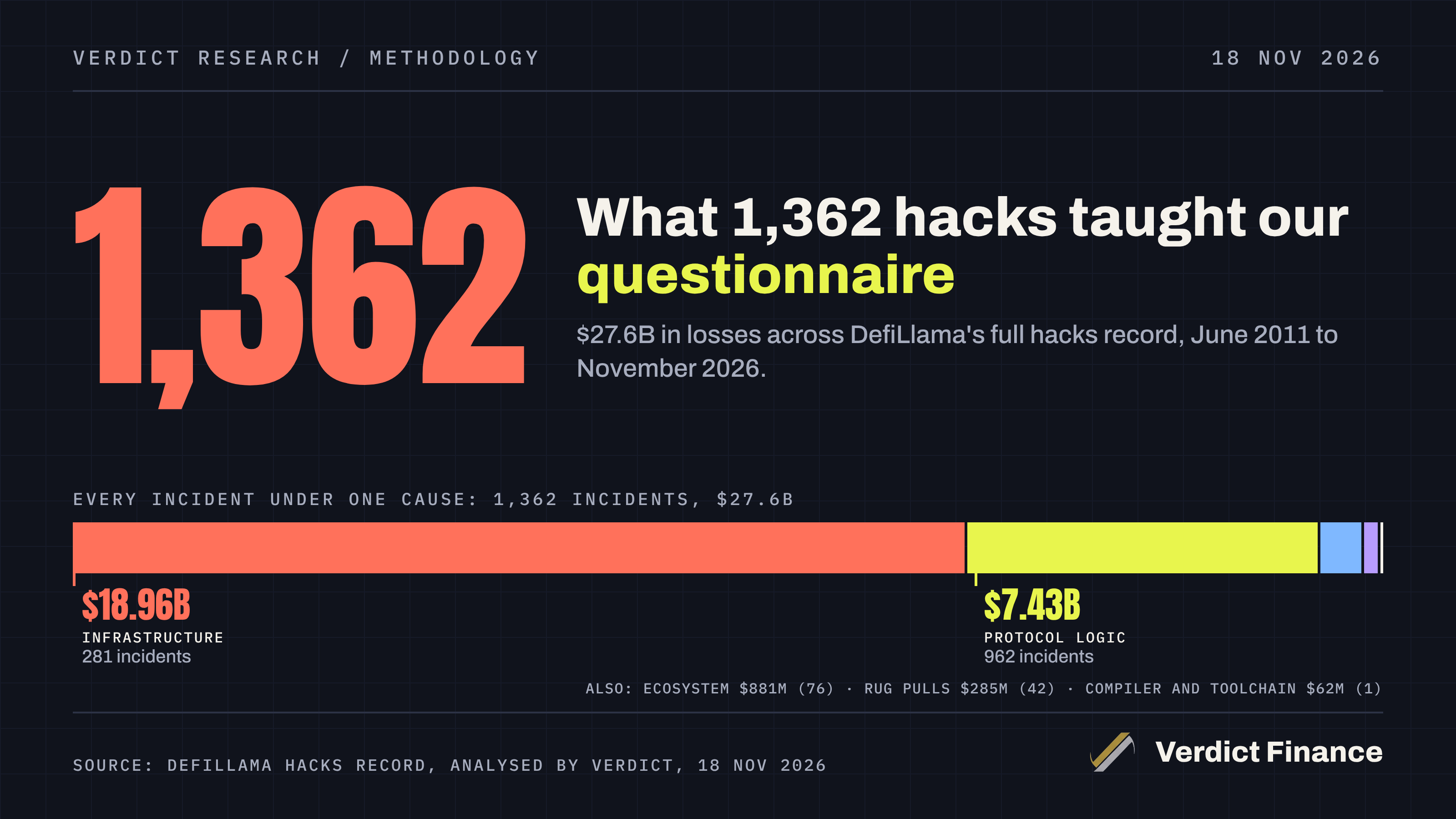
- Our questionnaire is built from a record of what has gone wrong: 1,362 recorded incidents and $27.6 billion of losses, June 2011 to November 2026, from DefiLlama's hacks record, exchanges included.
- The biggest single cause was stolen keys: every key-compromise technique together comes to $15.85 billion across 224 incidents. In DefiLlama's own techniques, the next biggest are signer phishing ($1.64 billion, 5 incidents), improper access control ($1.19 billion, 143 incidents) and a proof-verifier bug ($573 million, 4 incidents).
- That record is why bridge messaging security carries the heaviest weight in our bridge questionnaire, and why 27 of our 62 bridge questions name a real incident.
Why build a questionnaire from losses?
Because a rubric written from first principles drifts toward what is easy to check. One written from losses asks about what has actually cost people money. When a hack exposed a gap that none of our questions covered, we wrote a question for it.
The record started with 72 incidents, grew to 162, and was rebuilt in June 2026 on the 556 incidents DefiLlama had recorded then. It now holds 1,362, and the figures in this post are recomputed on all of them.
What has cost the most?
The figures below come from DefiLlama's full hacks record as of 18 November 2026. Each incident sits under one heading, so the rows do not overlap and sum to the total.
| Cause | Loss | Incidents |
|---|---|---|
| Infrastructure (keys, custody, social engineering, infra breach) | $18.96 billion | 281 |
| Protocol logic (on-chain contract bugs) | $7.43 billion | 962 |
| Ecosystem (front ends, dependencies, governance) | $881 million | 76 |
| Rug pulls | $285 million | 42 |
| Compiler and toolchain | $62 million | 1 |
The rows sum to $27.62 billion across 1,362 incidents. 69 of those incidents have no recorded loss amount, so they add to the count but not to the dollars.
Dollars in this record are lumpy. Three incidents, Binance CEX, LuBian and Bybit, account for $11.26 billion of the total. Incident counts show where the volume is: protocol logic is 962 of the 1,362 incidents but the smaller share of the money.
What did the record add to the rubric?
The analysis ran in tiers. Each tier took a group of incidents, asked which of our questions would have caught them, and wrote new questions where none would have. All twelve proposals from the first two tiers are live, and a third tier followed. In June 2026, a pass over the 556 incidents then on record mapped them into 62 defence requirements, found every requirement touched by at least one surface, and flagged 15 as needing strengthening. The resulting questions spec is complete.
The effect is clearest in bridges:
- Messaging security is the heaviest bridge domain, at 25. It asks how a bridge decides that a message from another chain is real, which is where the largest share of bridge money was lost.
- Lock-and-mint security is next, at 20. It asks what backs the tokens a bridge creates on the far side.
- 27 of the 62 bridge questions cite a named incident. Multichain, Nomad, Kelp, Ronin and Wormhole are cited most.
Does every question point at a hack?
No. Many questions cover governance, transparency and track record, where the evidence is a pattern rather than a single loss. The record decides where the weight sits, and it keeps us honest about whether a question earns its place.
What does this record not cover?
It is a record of exploits. Losses that needed no exploit, such as stablecoins that broke their peg, sit outside it. Those are covered in "Sixty-five stablecoins broke their peg and never came back".
Sources
- Verdict ratings and methodology: https://www.verdict.finance/products/ratings
- DefiLlama hacks record, for cross-checking incidents: https://defillama.com/hacks