Mechanism trees and dependency graphs: two ways to rate DeFi
By Verdict Research. Published 25 November 2026.
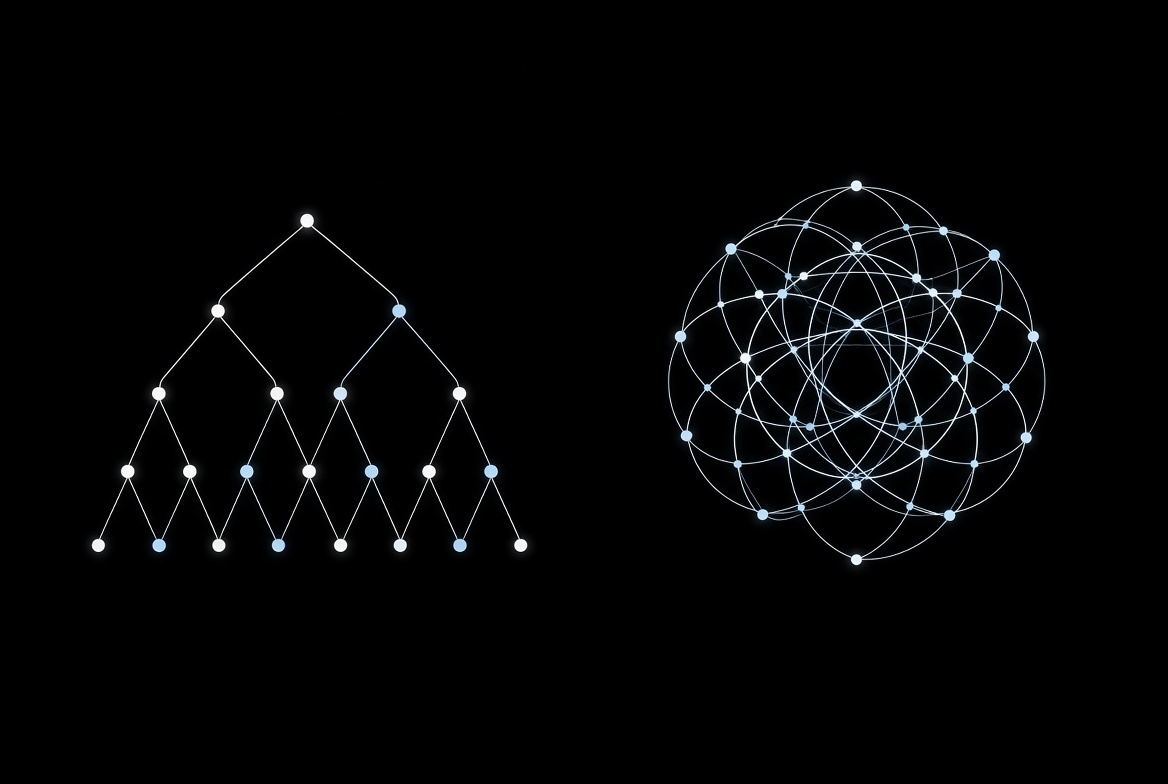
In short
- There is more than one serious way to rate DeFi risk. Xerberus, whose methodology is public, looks inside each object: it breaks a protocol, asset, pool or organisation into a tree of mechanisms and scores each one.
- We look between objects. We grade seven kinds of entity and let the links between them, such as a vault's oracle or a token's bridge, move the grade.
- Both publish their ratings free to read. We publish letter grades from AAA to D. Xerberus publishes a score between 0 and 1.
How does Xerberus rate?
From its methodology site:
- It rates four classes of object: assets, protocols, pools and organisations.
- Each object becomes a tree of mechanisms. Mechanisms an object does not have are pruned. Each one present is scored for its risk factors against safeguards backed by evidence.
- It scores each object from 0 to 1. Ratings are free, and Xerberus says it is never paid by the entities it rates.
Its homepage now leads with a forecast of tail risk, made by a members’ club whose members forecast how many failures each of 13 categories will bring this year and next. Members forecast how many failures each of 13 categories, such as stablecoin depegs or bridge drains, will bring this year and next. The forecasts are checked against an incident record of 1,125 incidents and $122 billion of priced losses, 2018 to 2025.
How do we rate?
- Seven kinds of entity: protocols, chains, tokens, oracles, vaults, organisations and bridges, across 306 questions.
- Two grades: a standalone grade from the questionnaire, and a headline grade that prices in what the entity depends on.
- Links that move grades: a dependency below B costs 2% per rank, scaled by how critical it is and by what that kind of link has cost before, capped at 30% in total.